What types of padel courts exist?
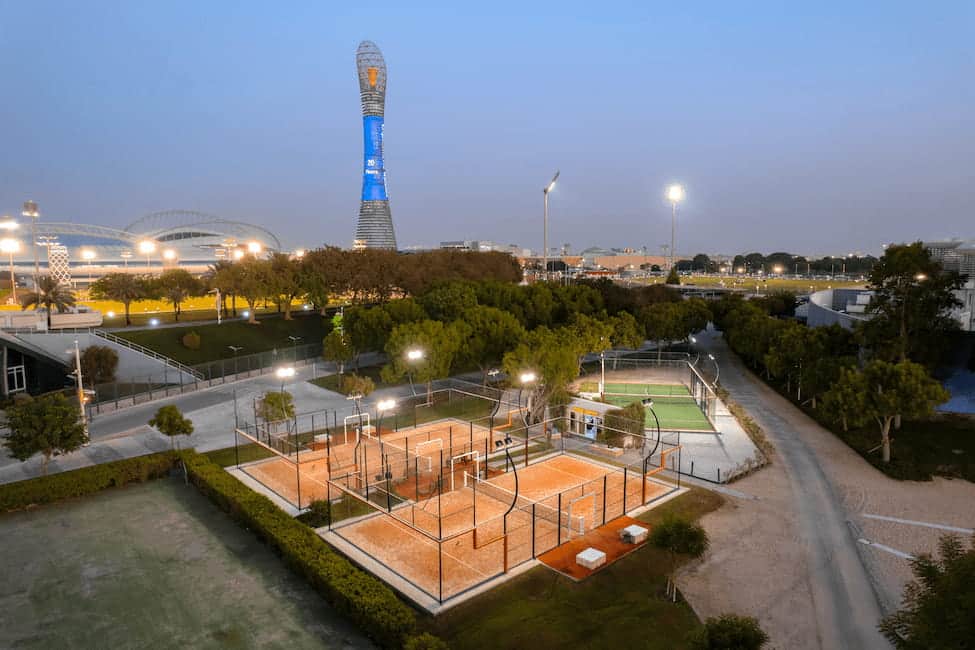
The success of padel lies in its high profitability per square meter and its accessibility for all types of players. Compared to a traditional tennis court, padel optimizes both space and investment:
- Efficient space: It occupies 200 m² compared to the 620 m² required for tennis.
- Higher capacity: It accommodates up to 12 players in the space that a single tennis court (4 players) would occupy.
- Higher return: It triples the flow of users and accelerates the club’s return on investment (ROI).
Below, we analyze the different types of padel courts, their materials, and how they impact gameplay and club profitability.
According to location: indoor vs. outdoor
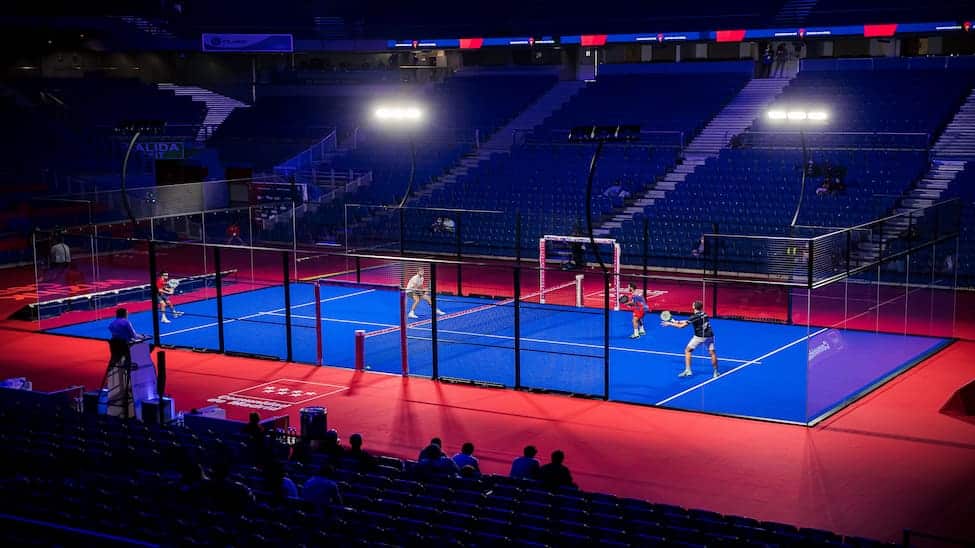
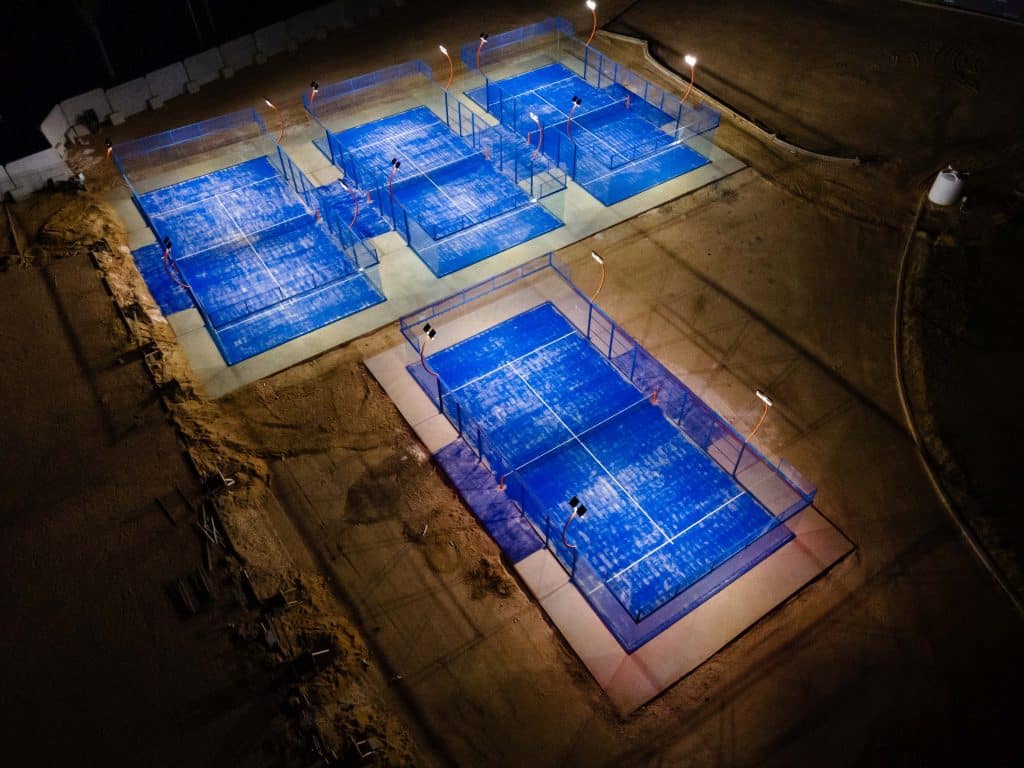
Padel courts are divided according to their location into indoor (covered) and outdoor (open-air) courts. Below, we compare their main differences:
| Feature | Indoor Courts | Outdoor Courts |
| Weather conditions | Guaranteed play with no rain or wind. | Subject to weather conditions (requires UV/sun protection). |
| Comfort & Gameplay | No sun glare; gameplay is influenced by ceiling height. | Natural ventilation and maximum sense of space. |
| Maintenance | Less wear and tear on materials and surface. | Higher wear and tear due to rain, thermal changes, and UV radiation exposure. |
| Lighting | Requires continuous high-quality indoor lighting. | Requires powerful LED floodlights for night matches. |
According to the number of players
1×1 Individual padel court
A 1×1 individual padel court allows for one-on-one matches. The main difference compared to a standard padel court lies in its dimensions: an individual court measures 20 meters long by 6 meters wide, as opposed to the 20 meters long by 10 meters wide of a double court.
Double padel court
A double padel court is the standard court used in official competitions and conventional sports facilities. These courts measure 20 meters long by 10 meters wide to allow for matches between two pairs. These are the official dimensions specified by governing bodies and sports regulatory standardizations.
According to the playing surface
Concrete padel courts
Concrete padel courts feature a rigid floor that delivers a faster ball bounce. Nowadays, almost all modern courts use artificial turf as their primary surface. Although building a concrete padel court can be much cheaper, this type of construction is gradually becoming obsolete.
Artificial turf padel courts
Artificial turf padel courts are the vast majority around the world. There is a wide variety of turf types that bring different dynamics to the game, slowing down competition speed thanks to their cushioning effect. Two main types can be distinguished:
- Monofilament turf: Higher silica sand infill density and greater traction.
- Textured turf: Lower sand infill requirements, making the sand barely visible.
Both provide similar playing conditions, differing mainly in the slide/traction mechanism. Artificial turf courts are the standard for professional competitions, such as the World Padel Tour.
Synthetic resin padel courts
Synthetic resin padel courts are less common in official competition venues due to their higher initial installation cost. These courts are known for offering excellent grip and a fast pace of play.
According to structure
Masonry / Concrete-wall padel court
Masonry or concrete-wall courts are often former tennis courts converted into padel courts. They feature a hard, rigid surface for ball rebound and isolate sound much more effectively. They are an ideal solution for steep slopes or unique site conditions where walls can serve as load-bearing structures.
Glass padel court
Glass padel courts are currently the most popular choice. Defined by a sleek and elegant aesthetic, they feature tempered glass panels between 10 mm and 15 mm thick, ensuring players a smooth and durable bounce surface while offering spectators an unimpeded view of the action.
There are 3 main categories of glass panel padel courts:
- Double court with tempered glass panels: Featuring glass back and side walls, where the panels are separated and framed by steel structural posts. Typically fitted with 10 mm thick tempered glass.
- Semi-panoramic court: The back walls have no vertical steel posts between the glass panels, though steel corner posts are retained. Typically uses 12 mm thick glass.
- Full panoramic court: The back walls, corners, and side walls are completely seamless with zero visual obstructions, offering a 360º panoramic view of the match. Typically uses 12 mm thick glass enclosures. These are the standard courts used in top-tier indoor and outdoor competitions.
We make any type of padel court a reality
In conclusion, there is a wide variety of padel courts designed to maximize both athletic performance and commercial returns. At Padelgest, we can help you configure the court that best fits the specific needs of professional players, padel clubs, and tournament venues.
We are an internationally recognized expert manufacturer and installer of padel courts for public sports complexes, private venues, and official competitions across different countries. Having installed our solutions on all 5 continents, we adapt our premium courts to any location and climate condition. Don’t hesitate to reach out to our team so we can provide a high-quality solution tailored to your exact requirements.