Smart use of padel court dimensions: Optimize land and multiply returns

The smart use of padel court dimensions goes far beyond meeting regulations. For investors and developers, understanding how these dimensions impact layout efficiency is key to optimizing available land, fitting more courts into the same area, and ultimately multiplying long-term returns. Strategic design decisions can transform a standard facility into a high-performance, high-profit padel complex.
Official measurements and how smart investors use them
What are the dimensions of a padel court? According to the International Padel Federation, the official size is 20 meters long by 10 meters wide, enclosed with glass walls and metallic fencing. For those working with imperial units, padel court dimensions in feet are roughly 66 by 33. Maintaining this global standard guarantees consistent playing conditions across clubs and competitions.
Padel vs tennis: getting more courts from the same land
When comparing padel court dimensions vs tennis court, the difference is significant. A tennis court requires more than twice the space, meaning that the same surface area can often accommodate three padel courts. For clubs, this translates into a higher number of members, more frequent games, and the ability to host events that drive both engagement and profitability.
Optimizing space for better gameplay and club success
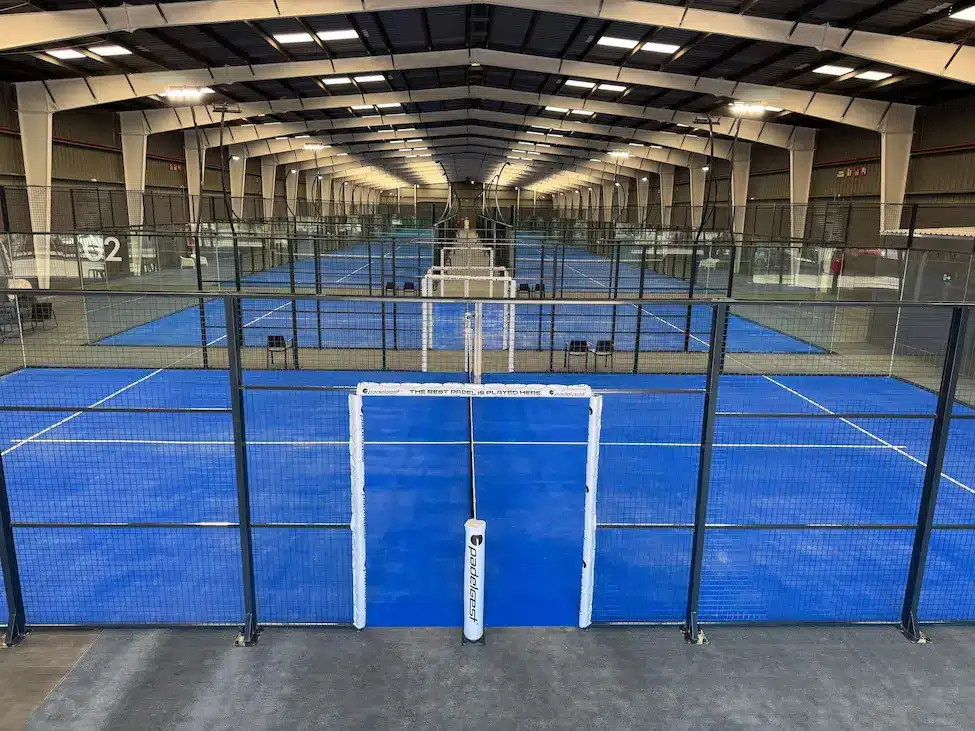
Designing a facility is not only about fitting courts into the available land. Strategic planning of padel court dimensions allows investors to arrange courts in clusters that maximize playable space and operational revenue. Attention to corridors, access points, lighting systems, and spectator areas ensures that space optimization also improves the overall playing and viewing experience.
Flexible layouts for evolving clubs
For smaller or multi-sport facilities, knowing the single padel court dimensions can help managers decide between one or two courts depending on demand forecasts. The difference between padel tennis court dimensions and other sports surfaces also makes it possible to integrate padel into mixed facilities without compromising functionality. Forward-looking clubs often leave room for future expansion, ensuring the site remains adaptable as padel demand continues to grow. For clubs facing space constraints, solutions like Coliseum Roof allow vertical expansion of courts and mixed-use areas, helping maximize playable hours, protect from weather, and increase profitability—all without needing extra land.
Design details that maximize efficiency and player value
Precise knowledge of padel ball court dimensions must go hand in hand with compliance on minimum free height requirements to ensure safe play. Beyond the playing area, clubs must also account for locker rooms, seating, service areas, and parking, as these elements shape both player satisfaction and the long-term success of the project. For more technical insights into construction, we recommend exploring our article on padel court measurements, which complements this discussion on space and design.
Padel court dimensions shape far more than the layout of a facility. They influence how efficiently clubs use their land, how attractive their venues feel to players, and how sustainable their business model becomes. When space is optimized with foresight and precision, every court adds not just playing capacity but also long-term value to the entire club.